The Apology of Socrates was written by Plato and Xenophon; with In Fed We Trust: Ben Bernanke's War on the Great Panic – How the Federal Reserve Became the Fourth Branch of Government, David Wessel (published by Crown Business) makes his bid to do the same for Federal Reserve Chairman Ben Bernanke (and Treasury Secretary Tim Geithner, to a lesser extent). While the book doesn't paint the actions of the Federal Reserve as infallible—if anything, quite the opposite—Wessel shows Bernanke and his colleagues' earnestness such that you can't really blame them: they realized they made mistakes and they did their best. The underlying implication throughout the narrative of the financial panic of summer 2007 to winter 2009 is that without Bernanke, it would have been worse.
I must admit, I went into reading this book (my second for the CFA book club) thinking that I would probably only like it if the title was intended to be ironic. Very quickly, its sincerity is evident. Wessel's day job is as a journalist for the Wall Street Journal, and for the most part the book reads like an extended article with an inside view to the Fed's actions over a period of almost two years, plus background of Bernanke and other major players (as well as the Fed itself). And that's fine so far as it goes. But, because of his extensive interviews and insider access to Bernanke and others (as indicated in the Acknowledgments) he almost fully incorporates their view of the world, so that he portrays it not as their opinion, but as the truth.
Chapter 2 explains the early history and development of the Federal Reserve, and it begins with the famous story of J.P. Morgan dealing with the Panic of 1907. Morgan's solution was clean: it didn't prevent problems because nothing can, but it looks a lot closer to the optimal than nearly anything in the episodes of the Federal Reserve from its creation in 1913. That series of failures reached its nadir with the Great Depression, for which Bernanke, then a Fed Governor, apologized to Milton Friedman in 2002. Wessel repeats that quote to end the book. Unwittingly though, Wessel's chapter on the early Fed anticipates the ineffectiveness, and sometimes cluelessness, of the Fed during the recent recession.
I remember when I took economics classes that looked at monetary policy in high school and college, we always learned the Fed had three tools: the reserve requirement, discount lending, and open market operations (fed funds rate). When I started looking at the Fed's website for work (June 2007), those same three showed up as the tools that they themselves claimed. In August 2007, they began to lower the discount rate, in September the fed funds rate. In December, finding that the discount window wasn't as effective as it should be, the Fed began its TAF program, and with that the Fed's tools began to grow from three, to around ten by the end of the next year. What neither Wessel nor Bernanke seem to care about is that when the interest rates were lowered in the fall of 2007, the price of oil (and other commodities) broke out of the cycle they'd been in the past few years, going up in the summer and down in the winter. That fall, prices continued moving up. Oil is an input to the production of nearly everything, so an increase in its price leads to a decline in the aggregate supply in the economy. The Fed's moves didn't do anything to arrest the problems in the financial markets, but they certainly were hurting the rest of the economy at that point. By not even dealing with this question, I remain in the belief that the higher prices hurt consumers, including in their ability to pay their mortgages. I'm open to evidence that this isn't the case, but Wessel presents none.
By January 2008's cumulative 1.25% rate cut in the span of a week, Bernanke seemed like he was panicking, whether the Societe Generale debacle had any influence or not. The brokered deal in March to save Bear Stearns was often invoked later as the precedent by which the market expected Lehman Brothers to be rescued too, six months later. No thought is given to the possibility that this makes the Bear decision wrong, rather than the Lehman decision. Rather than chiding the politicians for not having the will to act strongly between those events (on the scale of TARP), the Fed and Treasury should have used that time to work out more surgical and less costly ways to work on the problems. The financial system is a public good, but no single financial firm is.
TARP is emblematic of perspective Wessel brings. Despite being marketed so deceptively, no real consideration is given to any of the alternatives that were being discussed in September and October of 2008. My feeling at the time was that instead of focusing on assets, focus on liabilities. Even a worthless asset, if backed by equity, doesn't pose much risk beyond its owner. Rather, moves to shore up liabilities, through some kind of insurance or guarantee scheme could have better targeted those entities that were really in trouble. Anyhow, for Wessel and Bernanke and Paulson and Geithner, TARP was (and is) indispensible. The significant drop in the stock market the day the House first rejected TARP is taken as proof that the market believed TARP was necessary too; for a day or week, the market can through a tantrum too—that doesn't make it right. He skips mention of the market making up a lot of that ground the next day, when the bill's passage was in doubt, but acknowledges it went further down as and after Congress did approve it. Frankly, Wessel does no better than anyone else about what the real worst case scenario would look like. To me, any argument that one institution's failure would lead to drastic consequences in every facet of our lives is a case for radical decentralization—political and economic—that should start immediately. TARP did the opposite.
In response to recent propaganda by the likes of Geithner for claiming the success of TARP two years later, I want to share this piece I read last week. I don't agree with all Dr. Pitchfork's politics, but I think his economic analysis is solid. Basically, TARP did nothing to wring the risks from the Too Big to Fail standard out of the system. Since the last "dashboard" in June 2009, financial markets and unemployment are both higher, while the price of oil is little changed. We face the near prospect of further quantitative easing. I'd say the government in all its branches has done too much already.
Showing posts with label Personal. Show all posts
Showing posts with label Personal. Show all posts
Monday, October 18, 2010


Tuesday, October 5, 2010
Gregory of Tours: Asceticism in Clermont-Ferrand
I don't want to make this blog political, beyond the books I'm reading and my reactions to them (and I tend to prefer reading blogs or magazines for current politics over books), but the furor over Christine O'Donnell's past public statements on personal sexual morality have provided a certain frame for my recent reading of ancient and medieval Christians on the same subject. I have already discussed some of Jerome and Augustine's comments, and I expect to be writing more. Today, I want to focus on one story as a way to introduce Gregory of Tours. Gregory lived in the second half of the sixth century, and was a bishop. Though this would place him as more of a personality of the Middle Ages rather than antiquity, he was ethnically Gallic; thus, despite the collapse of the Roman Empire in what was evolving into France, he was part of a culture that was preserving Roman tradition and the Latin language. While the bulk of his History of the Franks concerns events in his native country, the beginning is something of a chronicle on Biblical, Roman, and ecclesiastical history at large. I am reading the translation by Lewis Thorpe for Penguin Classics.
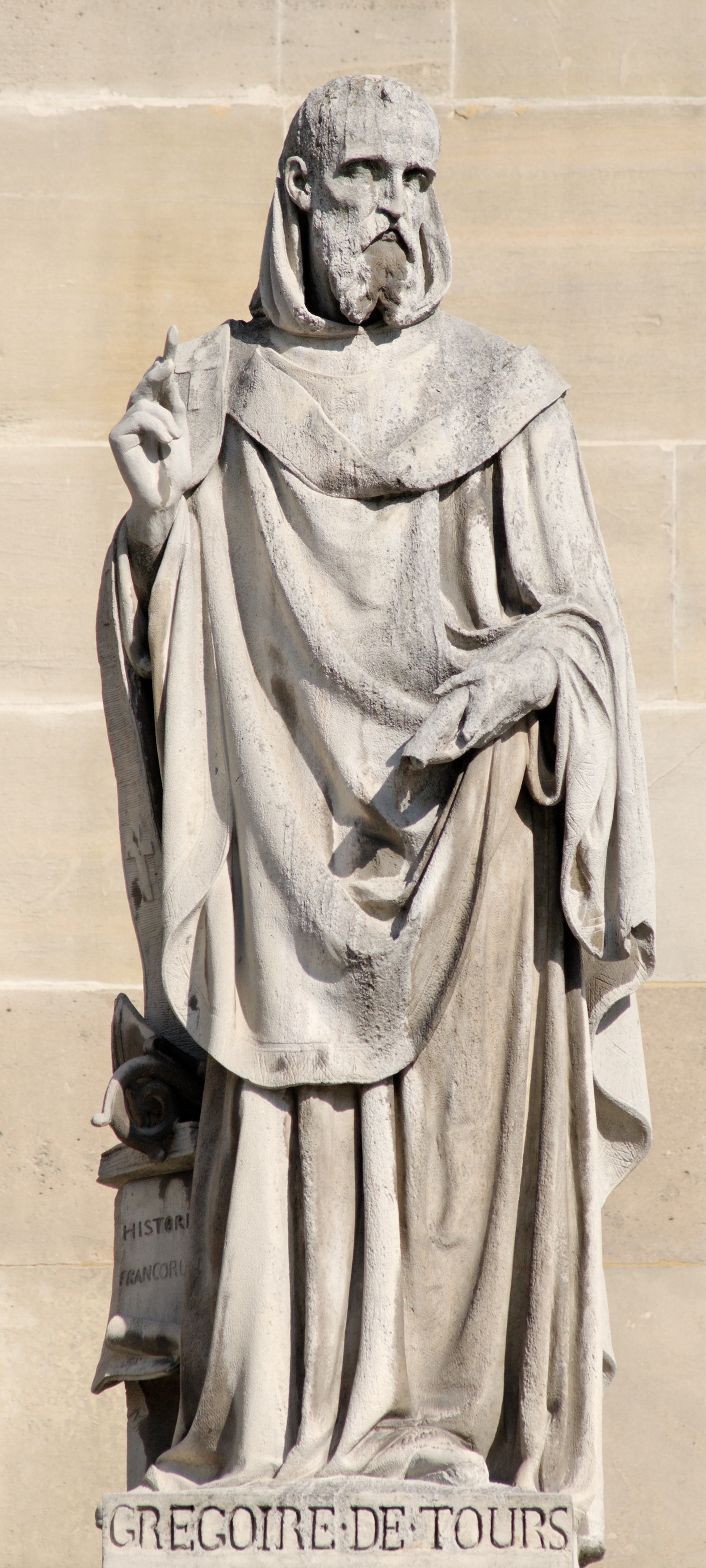
I mentioned below that Gregory wrote of the usurper Maximus and his meeting with Saint Martin (Book 1, Chapter 43). The following chapters concern the development of the church in Clermont-Ferrand—incidentally, I find this to be one of the best of city names. (It's also the place where Gregory was born [Introduction p. 7].) In Chapter 47, to cap off the discussion, he narrates a story, already known as "The Two Lovers," that reminds me of the style of the late Middle Ages, e.g. Boccaccio or Chaucer—although the latter two would be much more cynical of religion. A wealthy young man and woman marry; he's named Injuriosus, she has no name. Each is an only child, which is important for family inheritance. On the wedding night, before the marriage is consummated, the woman began crying. She explains that she had wanted to pledge herself to lifelong virginity and spiritual marriage to Jesus; she would rather be dead than have sex and has utter contempt for anything material. After a half-hearted counterargument on their parents' wishes from Injuriosus, she continued, "This earthly existence…[w]ealth…pomp and circumstance of this world…the very life which we enjoy is of no value. We should look instead to that other life which is not ended when death finally comes…by any illness…accident, but where man lives for ever in eternal bliss…radiance…with the angels…happiness which is eternal…in the presence of our L[-]rd Himself."
Injuriosus replied, "Your sweet words have brought eternal life to me…If you are determined to abstain from intercourse with me, then I will agree to what you want to do." In return, she agreed to maintain their outward appearance as husband and wife.
That night, and for the rest of their lives, they slept "hand in hand" yet "chaste." Eventually, she died, and Injuriousus prayed at her funeral, thanking G-d "for granting that I may hand back to Your loving care this treasure as unsullied as when I received her from Your hands." A miracle occurred, animating her dead body to smile and ask why he had said what he did. Soon, Injuriosus died as well. He was buried on an opposite side—I assume in the church, though it doesn't say—from his wife, yet the next morning their tombs were right next to each other, proving their spiritual love.
This tale is an inverted romance, and takes the Christian ideals of sexual asceticism to extremes. Gregory relates the story with all approval and praise, and is in company with Jerome, Augustine, and others. By contrast, what Christine O'Donnell advocated seems tame (or wild, I suppose).
A different translation is available online at the Medieval Sourcebook.
Monday, October 4, 2010
Jerome: What Exactly is Heathen Language?
After the surprising use of "heathen/gentili" I noted before, I have kept an eye out for further uses of the term. In each of the two letters by Jerome that are a part of my reading for the next segment of history, he noticed the word once. In Letter 52 to Nepotian, he transitions from quoting Virgil to quoting the Bible by calling the former "heathen literature" (Chapter 2). In this case the foreignness of the poetry is not being in Latin, as all of the letter Jerome writes is in Latin, but it being pagan. Clearly, this does not explain why he would call Aramaic/Syriac—a Biblical language—"gentili." The other reference I note is in Chapter 16 of Letter 54 to Furia. There, Jerome talks about how the prophet Elijah helped a "heathen widow." Again, the meaning is in pagan, but whereas, at least from Jerome's perspective, Virgil is "foreign" for not being Christian, the widow can only be not Jewish. (I realize Virgil died a few years before Jesus was born, but his the life of his poetry was mainly after the advent of Christianity, by numbers.)
In any case, these two examples both have Jerome using the word as synonymous with paganism, in which cases "heathen" is an appropriate translation, if still more derogatory than he seems to intend. "Mammon," however is a word that is part of a language spoken by Jewish people and early Christians, very much including Jesus. Thus, rather than finding other instances of the word elucidating the previous use, it has only added to my confusion.
A different translation of all Jerome's letters is at the Christian Classics Ethereal Library.
Sunday, September 26, 2010
Jerome: The Translator on Language
Jerome was already a part of my previous rotation, and I have also written about his acquaintance with Orosius and correspondence with Augustine. I am reading F. A. Wright's translation of Select Letters for the Loeb Classical Library. Among the letters I read for the current unit of history was Letter XXII "To Eustochium: The Virgin's Profession." Jerome is most famous for his translation of the Bible into Latin from its original languages, Hebrew and Greek; known as the Vulgate, this was the version the Catholic Church used until well past the Reformation. According to the introduction to the volume, Jerome worked on his translation of the New Testament during the years 382 to 385, while he was in Rome (xi). His epistle to Eustochium was written in 384.

At Chapter 31 of the letter, Jerome writes something that gob smacked me when explaining a famous passage from the Gospel of Matthew (6:24). The evangelist quotes Jesus as distinguishing between pursuit of "G[-]d and Mammon." Jerome says, "By Mammon understand riches: for in the heathen tongue of the Syrians riches are so called" (italics added). Though it's usually cumbersome, I was glad to have the original Latin facing me with this passage, so I could see that the word "gentili" is what Wright translates as "heathen." First off, I assume that Jerome considers Syriac and Aramaic to be basically the same language; if that's not true, it should be close enough. Biblical scholars often think that passages that have an Aramaic character in the Gospels are more likely to be authentic to Jesus' own teachings, though the method is not infallible. The use of "Mammon" is an obvious case of this, for Matthew retains the Aramaic word rather than translating into Greek. Whether Jesus actually said the passage or not, Matthew wants us to think so, and if he did say it, "Mammon" wasn't the only word he said in Aramaic – the whole teaching was in that language.
So why would Jerome call it a "gentile" language?!? (I will eschew the translation of "heathen" because that has a negative connotation I don't think Jerome intended.) Even with Christians not being included as gentiles, how could Jerome label the words that Jesus spoke in that way. Despite being so committed to the translation process, he reminds me of the admonition one sometimes sees today against thinking that Jesus spoke the language of the King James Bible. Aramaic may not be the Holy Tongue, but it is closer – both linguistically, and (to Christians) because Jesus spoke it – than Greek; Greek is the language of the New Testament, but some parts of the Jewish Bible are Aramaic rather than Hebrew. Considering that until Jerome the Bible only existed in Latin in very poor translations, Latin is even further from "holiness". If he had said "foreign" or even "barbarian," I could understand, but already in those times, "gentile" referred to someone outside the Abrahamic tradition. Either the language is Jewish/Christian enough, in which case the designation is misplaced, or it really is gentile, in which case Latin is too so the words has no use.
A different translation (although the pertinent passage is no different) of Jerome's Letter to Eustochium is available online at Fordham University.
Wednesday, September 22, 2010
Boeckh: What Goes Up, We Can’t Let Come Down
For my first time at the CFA Society of Chicago Book Club, I read The Great Reflation: How Investors Can Profit from the New World of Money by J. Anthony Boeckh, published by John Wiley & Sons. He describes how the government is trying to recreate the positives of economy that ended when the bubble crashed in 2008, but without recreating the same excesses. The book is divided into three parts.
Part 1 concerns the causes of the recession. Inflation and debt are conventional and hard to disagree with. Then, in Chapter 3, he turns to a theory of "long waves" in economic cycles. While Boeckh doesn't think that such waves are completely controlling of what will happen in the economy, he also doesn't seem to think economies can escape them. He explains a history where economies are in a positive wave for about a quarter century and then a negative wave for a quarter century. Nevertheless, he thinks we've been in a down wave since the early 1970's, that was interrupted in the 80's and 90's, only to continue. He concludes that this wave will continue for at least a few more years. I appreciate the Schumpeterian reasons he cites for cyclicality in the economy, the argument about the timing for the waves sounds a lot like permanent advocates of a market condition talk no matter what reality is saying that he condemns elsewhere.
Part 2 is about how to invest during the period of reflation. As Boeckh discusses each asset class, however, his advice is mainly that which could be given at any time. For stocks, he recommends fundamental analysis, with some help from behavioral and technical insights; obviously, that was no less true a couple years ago, or even decades ago. He said we were at the end of a long bull market in bonds, which is for the most part necessarily true because nominal interests rates have become so low, although he was writing before the last run up in bond prices since May that he didn't seem to expect. He's bearish on the dollar, but every other major currency has problems too. Gold is probably following a similar bubble pattern to that of the 1970's and early 80's. The chapter on commodities is best; while this class may provide decent diversification and inflation protection in the short run, data going back two centuries shows that they horribly underperform. The real prices of wheat, cotton, and copper are down 75% to 85% since 1800 because technology will always allow the supply to rise to meet the demand. Similarly, the real price of real estate tends to appreciate very slowly over time, with the bulk of returns coming from the flow of benefits, be they rental cash flows or the real benefit of living in a house.
Part 3 tries to tie everything together, but without much success. It's easy to say that the U.S. is in at least relative economic decline, because there was a time at the end of World War II when it had a majority of the world's productive capacity. He seems pessimistic about politicians making what he considers the right decisions about the economy; he probably would like the Tea Party movement even though they are for fiscal austerity. He cites a wave theory of politics and the economy; I cannot take this idea seriously as it says that 1933, when FDR came to office, and 1985, when Ronald Reagan was re-inaugurated, were both "conservative" highpoints. In the end, though, he thinks we'll muddle through.
Most of the other members of the book club agreed with me that the book was disappointing. The investment advice was not very helpful, and the economic analysis was either not very rigorous, too tepid in its conviction, or an unfortunate confusion of fact with opinion.
Sunday, September 5, 2010
Reading with 10 Eyes and 17 Bookmarks
My first forays into classical history were with some relatively obvious choices, Herodotus and Livy. When I reached the adventures of Alexander the Great, I found that I had four different sources with nearly equally compelling value: Plutarch, Arrian, Quintus Curtius Rufus, and Diodorus Siculus. In order to maximize my ability to find the differences in their narratives, I attempted to read about each event discretely in all four authors before moving on to the next passage in each. The sources extent for the early third century before the common era are quite poor, forcing me to find more of them. Even when the great Polybius starts and then Livy resumes for the Second Punic War, I had built up a cycle of eight to twelve different books I was reading at once. While those observing me might find it strange, especially when the passage I read is only a sentence or a paragraph from any given book, the repetition helps me learn, and the differences reveal both what is better to believe is true and also the perspective of the authors.
My last rotation, covering the years 378-383 CE, included the following books: the History of Zosimus, the Histories of Al-Tabari, the Gothic History by Jordanes, Gregory of Tours' History of the Franks, Bede's Ecclesiastical History of the English People and Greater Chronicle, The Anglo-Saxon Chronicle, the Ecclesiastical Histories of Sozomen and Socrates, Libanius' Autobiography, Letters, and Orations, Letters of Saint Jerome, and the Confessions of Augustine. Because of both curiosity and the belief that they are in themselves classics, I also include Montesquieu's Considerations of the Greatness of the Romans and Their Decline and Edward Gibbon's Decline and Fall of the Roman Empire.
If anyone has any questions about these or other books, such as what I editions I use, go to my profile in the sidebar and send me an email.
Introduction
Welcome to my new blog. I have read over eleven centuries of classical history using ancient sources (I take the founding of Rome as my starting date, roughly in 750 BCE, and have reached the death of the emperor Gratian in 383 CE). This blog will be my vehicle to attempt to explicate both what I have read and what I have learned. In addition, I will discuss some larger theories about why history unfolded as it did. For example, I posit that Hannibal of Carthage was among the most responsible of actors for the downfall of the Roman Empire, despite losing two wars to them. Stay tuned to read how.
Beyond pure history, I will delve into other fictional and non-fictional sources that elucidate how life was lived in the period. While a reliance on ancient sources incorporates the limitations of the authors, including both their ignorance and biases (no different from a modern there), such writing tells us what the ancient people understood. False knowledge may better explain future action when the truth was unknown. Considering that, I take what I read from ancient historians as effectively true as long as there's not another ancient historian who disagrees, or a modern editor or translator whose help I rely on has not made a compelling argument about why they should be taken as a complete legend.
I very much welcome comments and hope this will be an opportunity to meet new people who have some of the same interests I do. I was a minor in history in college, but I think that this kind of learning can be a lot more enjoyable reading when it is only done for fun rather than for class. If similar people are out there, then let's make this a two way street.
Subscribe to:
Posts (Atom)